Stories by Storie

Everyone has a story to tell. What is yours?

  • Stories by Storie
  • Home
  • About
  • Blog
    • Book Activities
    • Book Lists
    • Classroom Management
    • Freebies
    • Math
    • Reading Tips
    • Writing
  • Free
  • Shop
    • Teachers Pay Teachers
    • Amazon
    • Bookshop
  • Subscribe
  • Contact

5 Quick & Easy Ways to Group Your Students

November 22, 2021

Have you ever asked your students to find a partner? I have and the same problems happened year after year. There is a way to make this process easier and more manageable. Here are five quick and easy ways to group your students using supplies you probably have in your school or classroom.

Grouping your students doesn't have to be a challenge. Here are 5 quick and easy ways to group your students using supplies you probably have in your school or classroom.

Ways to Group Your Students

Looking for some quick and easy ways to group your students? Here are some of my favorites.

Popsicle Sticks

Many classrooms already have Popsicle sticks (aka tongue depressors, craft sticks, etc.), which makes them a great tool for either picking partners or creating groups. This is a completely random way to partner students, so use it carefully!

I kept a jar of sticks with my students’ names on them. These were used to randomly call on students during a lesson or to share. When I needed to partner or group students, the jar of sticks were already close by and handy, so it was a no-brainer for me.  

If you color your sticks, you have a couple of options. You can use sharpies, highlighters, or markers to color the sticks in groups of 4 (4 red, 4 yellow, etc.). You can pass out sticks or have students do a blind draw. Students must find a partner (or group) with a matching color. But, if you really want to throw your students for a loop, have them pick whatever color they want. You know that friends will make a plan from across the room so they end up with the same color. Then you throw your curve ball…tell them their group must be represented by 4 different colors.

Clock Partners

Clock partners (similar to Speed Dial Friends) is a management strategy that has been around for awhile and I have learned that not all teachers use clock partners in the same way. Here’s how I used it in my classroom as an option in which I still maintain a little control over who works with whom (and when).

First, you’ll need a paper for each student to record their partners on. Here’s an example:
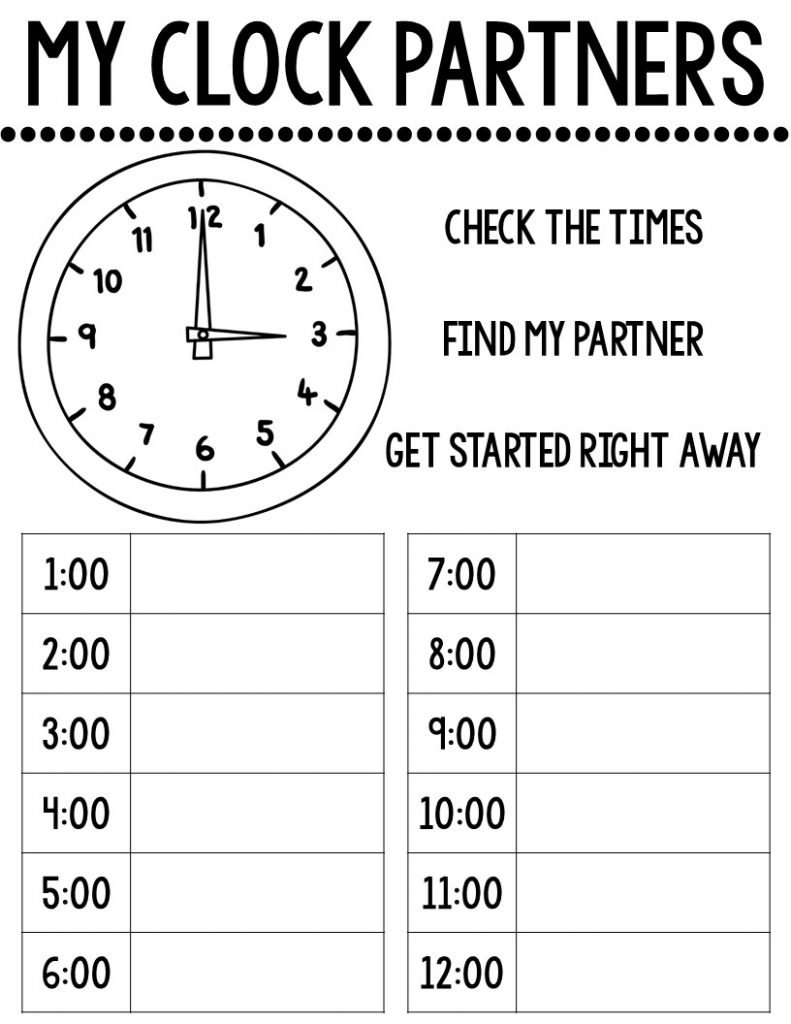
This takes quite a bit of time to set-up, but it is a quick way to partner students up once it is finished. If you want to keep control over who partners with whom, have your students line up, but keep all of your most difficult students together at one end of the line (either front or back). Now fold your line in half so that your students are each facing a partner. It might look something like this in a class of 24 students (most difficult students are marked in red):

Have students record this partner’s name in the 1:00 time slot. Students 1 and 24 are partners, 2 and 23, etc. To find the next partner, keep one half of your class in place (the half with your more difficult students). The other half will slide one spot to the right (person on the end will walk around to the other side).  

It might look something like this:

Have students record this partner’s name in the 2:00 time slot. Students 1 and 13 are partners, 2 and 24, etc. Continue until all slots are filled.

Not all classes come in neatly packaged numbers (as you know). If you have fewer than 24 students, you might not want to use all 12 time slots. You also might choose to make a time slot a free choice. If you have an odd number, the odd man out can write down your name. When a new student arrives, substitute the new student’s name in your place.

The next time you need students to partner up, just call out a time and students check their times, find their partners, and get started right away!

Deck of Cards

Most classrooms also have a deck of cards lying around, which makes this a great tool for creating partnerships or groups at random. A standard deck of cards has four numbers in four suits. Start by laying out the cards you will need. For a class of 24 students, you would pull out all of the aces, 2s, 3s, 4s, 5s, and 6s. Then shuffle and deal out the cards. If your activity needs pairs, students must match the number and color. For groups of 4, students must match numbers OR find a group where all four suits are represented, regardless of number.

Puzzle Pieces

This is another fun pair-up idea that takes more prep work, but can be tied into your academic content fairly easily. The first thing you need is puzzle pieces. I think the clipart variety work well because you can print them and add your own text. Here are some free puzzle piece clipart sets from Krista Wallden (Creative Clips) that are perfect for this project: Set 1 | Set 2.

So how do you tie this into academics? Working on synonyms? Write matching pairs on the puzzle pieces. If you’re working on multiplication facts, write the problem on one piece and the product on the other. By laminating the pieces first, you can write on them with a vis-a-vis marker and change them as frequently as you want!

If you have old puzzles lying around, take 2-4 pieces out of each puzzle that interlock. Flip them over and write the academic content on the backside and you’ll be all set!

Using puzzle pieces will create partners or groups at random. If you want to maintain a little more control over this process, print the puzzle pieces on different colors. Then choose to pass out the pieces and make sure certain students receive different colors.

Scrabble Tiles

Somehow I always have a Scrabble game (or a making words game) on hand for students to practice their spelling and sight words. It’s pretty easy to find pairs of letters you need in a matter of seconds.

If you want to up your game a bit, create 6, 4-letter words using the tiles. Then throw all of them into a bag, jar, or cup. Have students draw one tile each. Present the 6 words to your class and have them make groups by spelling out the words.  

If you don’t have Scrabble tiles, but still want to try this, there are many Scrabble-like fonts you can download for free. Just type them into your program of choice, print, and cut them out.  


I hope these ideas help you group your students in new ways.

If you’re looking for more classroom management ideas, try these:
  • Ways to Get Your Students’ Attention
  • Tips for Managing Hallway Behavior
  • Classroom Management Tips
Are you struggling to group your students quickly and easily? Here are 5 ways you can group your students using supplies most classrooms already have.
signature

Related posts:

3 Tips for Managing Hallway Behavior Snack Time {Pros and Cons} classroom moneyClassroom Economy: How I Use Money in the Classroom Picture Books for Goal Setting Finding papers without names on them is not only frustrating, but tracking down the owners can be time consuming! Here are several tips for preventing and handling no name papers in the classroom.Tips for Dealing with No Name Papers
«
»

Filed Under: classroom management, teacher tips Leave a Comment

Leave a Reply Cancel reply

Your email address will not be published. Required fields are marked *

Search

Categories

Latest on Instagram

My favorite library find this week takes an up clo My favorite library find this week takes an up close look at the epic journey of a Pacific salmon.

If you live in the PNW, the 4th grade students probably study the salmon life cycle at some point during the year. If they’re lucky, they even get to help care for some of the eggs for months at their school before releasing the salmon fry into a local creek. I know I got to do this when I taught 4th grade, and my own kids did, too!

This book combines beautiful illustrations with inviting & informative text that captures each unique stage of the Coho salmon. The back matter provides additional information about the life cycle stages. It would be a fantastic addition to your salmon or life cycles unit!

➡️ Swipe to take a peek inside!

Have you seen this book yet?

Salmon Run; An Epic Journey to the Ocean and Back
📚 @redcometpressbooks 
✏️🎨 @annichenn
🐷🐷🐷 There’s something timeless about The Three Li 🐷🐷🐷

There’s something timeless about The Three Little Pigs that captures the imagination of readers of all ages. Whether you reach for the traditional tale or one of the fractured versions, these stories offer a delightful mix of adventure, cleverness, and humor!

What’s your favorite version of The Three Little Pigs?
💛 LIBRARY STACK 💛 Thought I’d stop and take a mom 💛 LIBRARY STACK 💛

Thought I’d stop and take a moment to admire my current checkouts from the local library, especially since I was recently reminded that February is National Library Lovers’ Month. 

Do I often get strange looks and questions when another patron sees me with a large stack of picture books at the self-checkout desk? Yes, but that hasn’t stopped me! 

Which titles from this stack would you reach for first?
My favorite library find this week dives deep bene My favorite library find this week dives deep beneath the surface to explore hidden treasures.

Alternating between verse and facts, this book gives readers a front row seat to some of the biggest shipwrecks ever found. We also get introduced to some of the scientists, divers, and treasure hunters behind these discoveries. 

Whether you know an aspiring marine archaeologist or someone who loves a good treasure hunt, this book would be a good fit for any curious, adventurous reader!

Have you seen this book yet?

Shipwreck
📚 @tilburyhousepublishers 
✏️ Deirdre Laide
🎨 Carlos Velez Aguilera
A princess who is intelligent, has a kind & gentle A princess who is intelligent, has a kind & gentle heart, and one who stays true to herself? Yes, please!

Set in the mountains of Joseon, we meet Jeongsoon. She has a heart of jade, and wants to become princess so she can help the hungry children in her village. 

It isn’t long before she enters the Princess Challenge and faces three tests: Manners, Wisdom, and the Sleep Test.

While Jeongsoon is far from perfect, she stays true to herself and wins the favor of the queen. 

This story adds a fresh perspective on the classic tale of The Princess and the Pea. My favorite part was the Sleep Test twist! I love that the backmatter includes information about the real-life Queen Jeongsoon of South Korea.

A big thank you to the publisher for sharing this new picture book with my family! 
✏️ @tinamcho
🎨 @honeej
📚 @MacKidsBooks

Which do you prefer?
• traditional tales
• reimagined/fractured fairytales
• both
My favorite library find this week combines friend My favorite library find this week combines friendship and adventure with a story about how paper is made.

Under a tree, a boy with a book and girl with a paper plane meet and play over the course of a wonderful day. Then they are parted - perhaps never to meet again. 

Soon their tree is felled and starts a new journey to become paper to make hundreds of different things...including a book for a girl and a notepad for a boy. 

Can a new paper plane find its way to reunite the friends again?

⭐️ Not only would this story be a great addition to your friendship collection, but you might want to check it out before Earth Day since it also explains how paper is made. 

Have you read this book yet?

Paper Chase
📚 @scholastic
✏️ Julia Donaldson
🎨 Victoria Sandøy
As teachers and parents, we want our kids to be ki As teachers and parents, we want our kids to be kind to others. Through books, we can show students how to see the good in others, how to be there for other people, how to help others feel included, how to be kind even when it is hard, and how spreading kindness can come back around.

In other words, books can help us send the message that kindness is important and something we value. 

🩷 What are your favorite kindness books for kids?

🔗 Full list available on my website and Amazon page.

Copyright © 2026 · Website Design By Jumping Jax Designs