




Stories by Storie

Everyone has a story to tell. What is yours?

  • Stories by Storie
  • Home
  • About
  • Blog
    • Book Activities
    • Book Lists
    • Classroom Management
    • Freebies
    • Math
    • Reading Tips
    • Writing
  • Free
  • Shop
    • Teachers Pay Teachers
    • Amazon
    • Bookshop
  • Subscribe
  • Contact

Morning Work – Using a Daily Math Review

September 17, 2015

I have tried all kinds of things for morning work over the years.  Each has had its own pros and cons, but nothing ever seemed to be the right fit for my teaching, curriculum alignment, or student needs.  So what does a teacher do in this case?  She creates something that will work.

My colleagues and I use a Daily Math Review (we call it DMR for short).  It is similar in concept to what you might find in a teacher resource book, but it has been created and tailored to fit our students.  Yes, that means it’s a lot more work for us, but it is incredible how much growth and progress our students make.

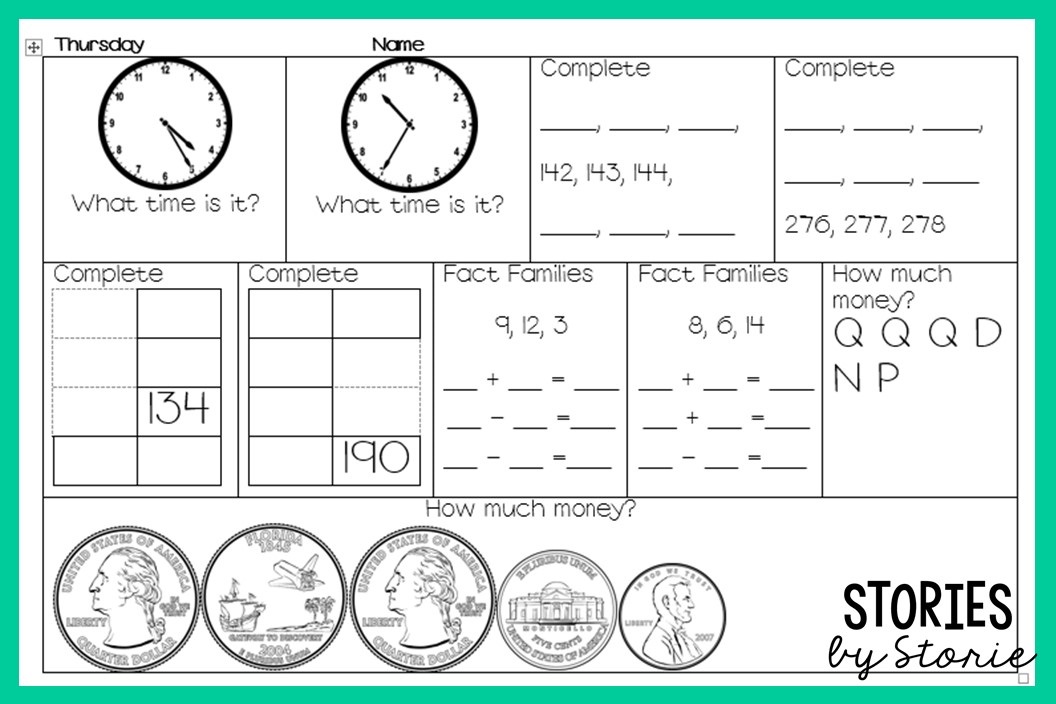
When we started, we knew we wanted to focus on five skills.  Second graders always need practice with time and money.  We start by reviewing time to the hour and half hour.  For money, we keep the totals less than 75 cents and the coins are in order from largest to smallest.  After that we decided number grids (hundreds), number patterns (counting by 1s), and tally marks would be a great place to start.  We knew we wanted two problems for each skill (10 problems is not overwhelming and super easy for grading purposes).  Here is what my very first DMR page looked like:
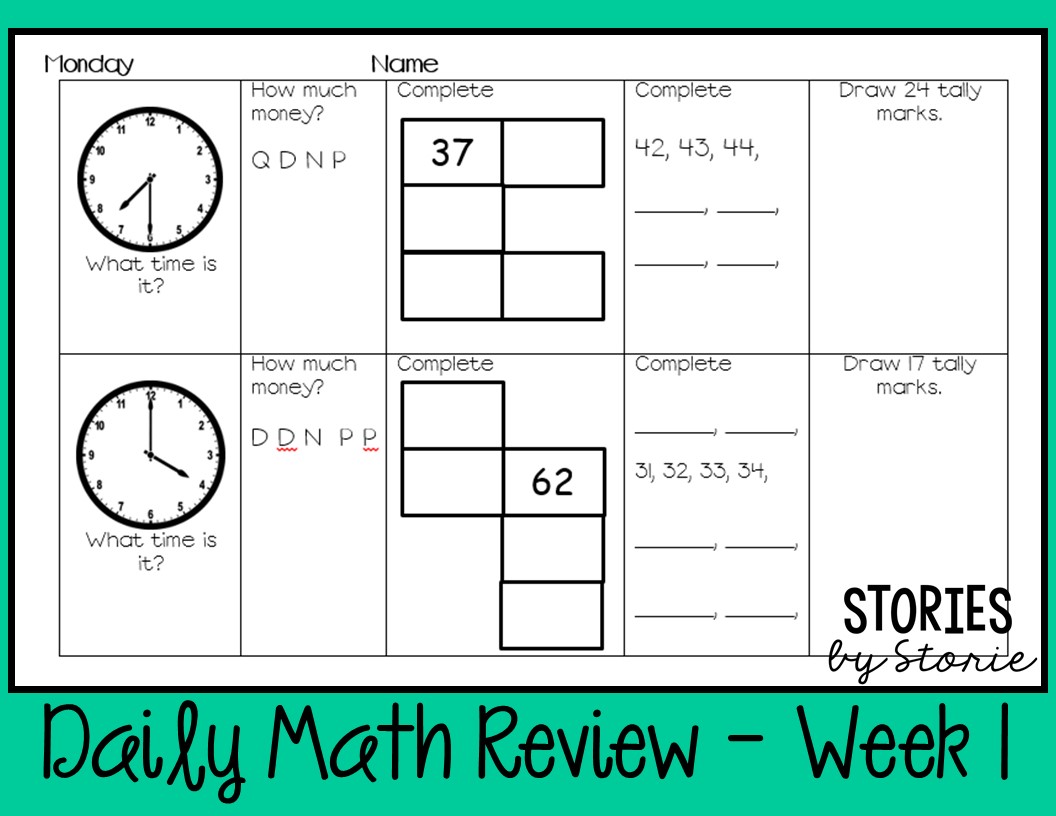
(sorry about the red lines under the coins – this was a screen grab)

Every morning (Mon – Thurs) my students would enter the room and find their DMR page already on their desk.  They work on it and flip it upside down when they are done.  When all students have finished (or when the clock shows 9:30), students gather back at their desks and we correct together.  The reason I correct together is it gives me four days of time to teach and/or review these skills.

On Fridays, the students have a quiz.  The quiz actually has the exact same problems the students have seen throughout the week (a few problems taken from each day’s paper).  The quiz is 100% independent and they do not get any help from me.

During quizzes and tests, my students have offices up on their desks.  When students finish, they go directly to an independent choice (read to self, independent math game, work on writing, or incomplete work).  I start grading as the students are finishing.  Each box is worth 1 point, or 10% of the final grade:
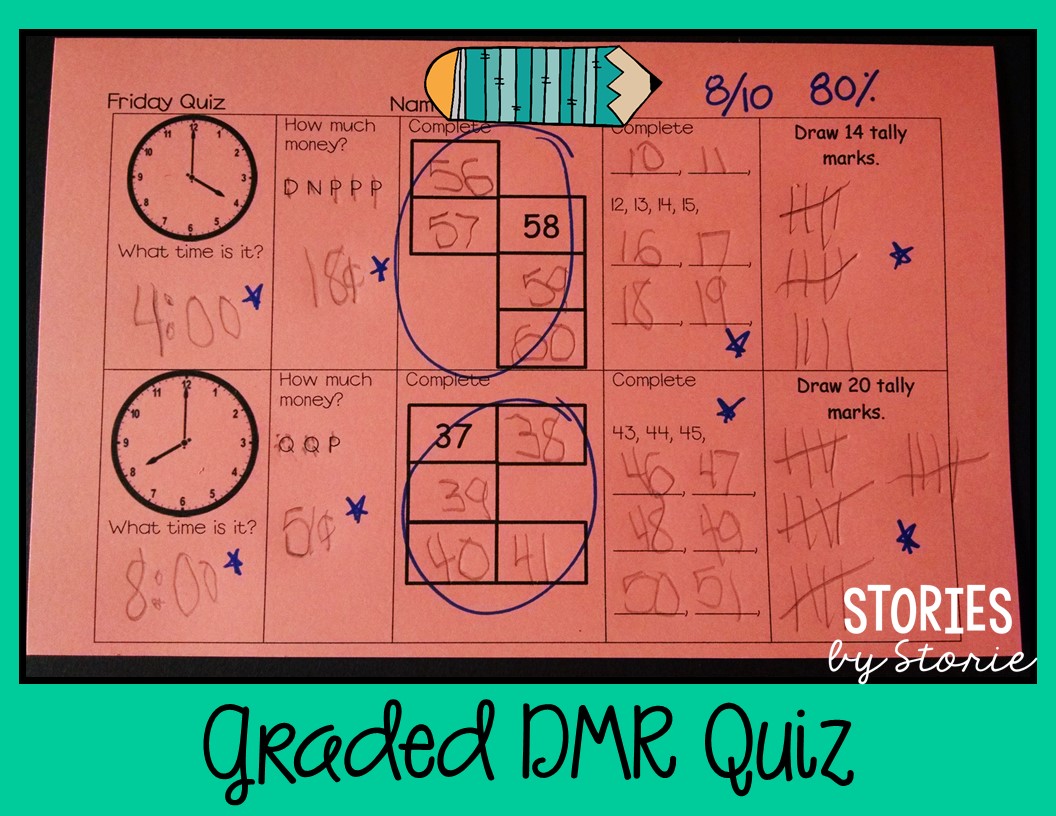
As I’m grading, I’m making some mental notes about common errors.  I will target these during corrections the following week.

I record the individual scores into my grade book as percentages:

The next thing I do is calculate classroom scores for each box.  I get *super fancy* and make boxes and tallies on the back of a blank quiz.  Each tally mark represents one student that answered the problem correctly.  I also calculate what percentage of the class answered each problem correctly.  The final thing I do is calculate the percentage of the class on each skill, since they are actually being tested twice (that part isn’t shown, but it’s basically taking the average of the top and bottom box):
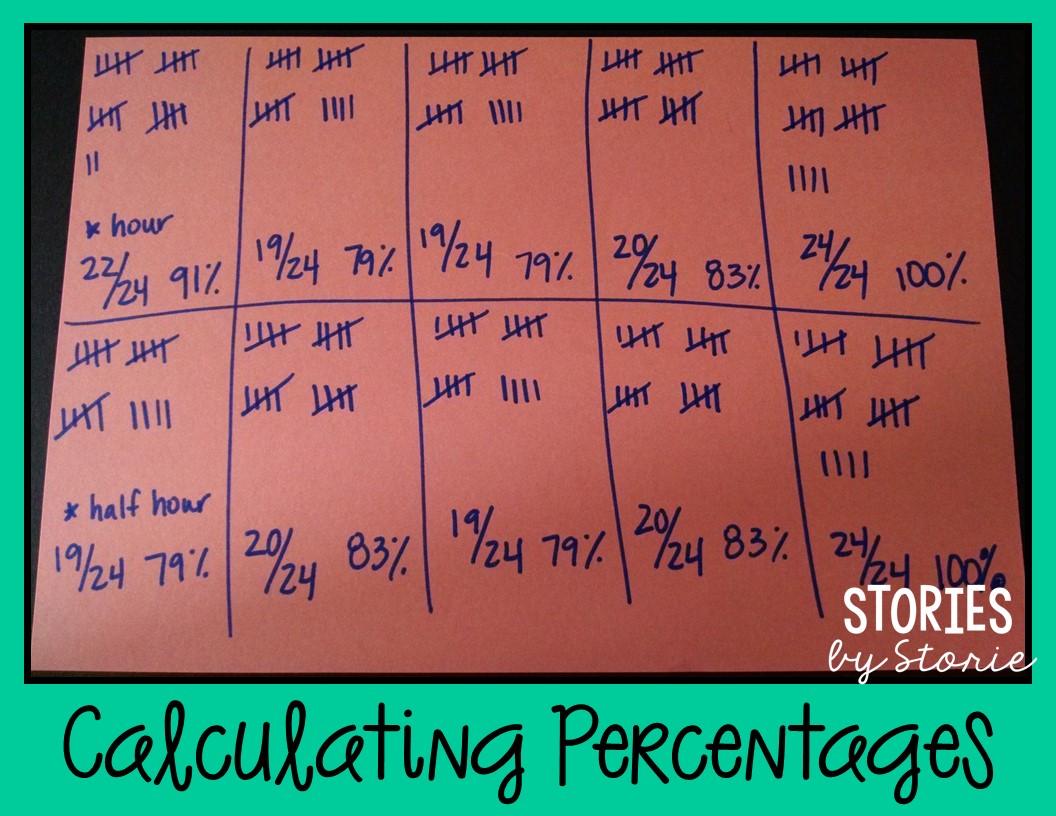
This information is then interpreted.  Are my students ready to move on to the next skill level?
If not, I ask myself the following:
Was it a bad question?
OR
Do my students just need more teaching or practice?
I also compare my classroom percentages with my 2nd grade colleagues.  If one teacher’s class is scoring 90% on counting coins and mine is only scoring 65%, it opens the door to a conversation about how a colleague is teaching the skill to her students that might improve my own teaching.

We also use our DMR scores to form intervention groups for math.  Here is a page of data I brought to one of our collaboration meetings (no, I don’t usually take the time to type up the data):
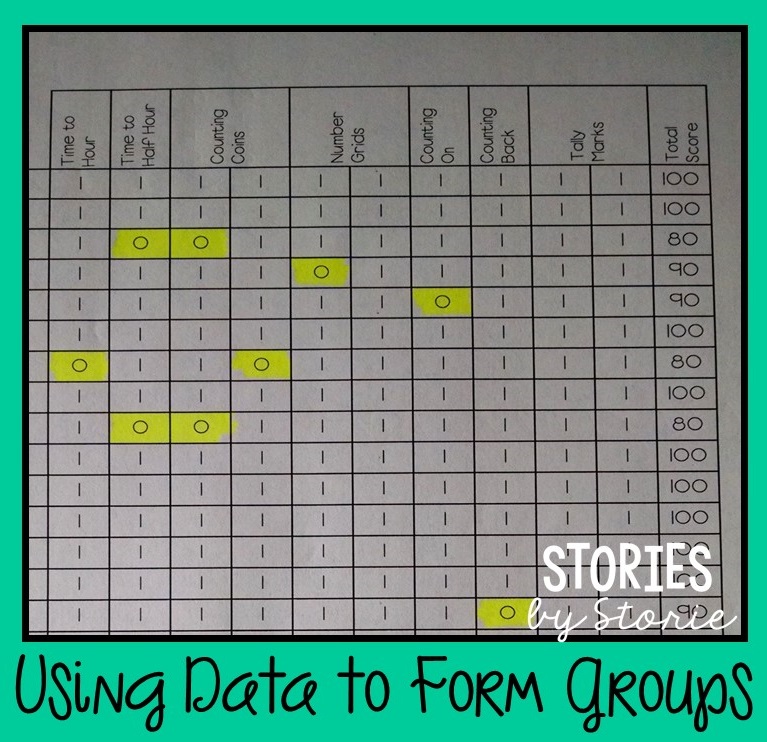
At this point of the year my students were doing quite well on the skills being assessed and I only put one or two students into intervention groups.  However, one of my colleagues had a handful of students who were struggling.  We identified the skills that needed the most work, the students who needed the most intervention, and divided them up.  We then ran intervention groups and reassessed the progress made (our intervention groups are usually 2-3 weeks on a skill, 4 days a week, 30 min. a day).

When our classrooms are scoring 85% or 90% on a skill, we move to the next level or if we feel we have reached the end of one skill, we swap it out for a new math skill.  Let me share a few examples of how the DMRs progressed through the school year:

Friendly 2-digit numbers, time the half hour, and coins are still heads only, largest to smallest.


About a month later, time is to the 5-min. interval, numbers are in the hundreds, and coins are still in order, but we’ve starting using heads and tails.


Things just got harder – notice the missing addends and now the coins are mixed up, too!


This is much later in the school year.  Time is to the minute and addition and subtraction have regrouping.  It’s amazing just how much this particular class learned!

As I mentioned, this is tailored to fit the needs of an individual class (or grade level, as we compared all second graders).  Here’s a glimpse of the previous year’s class at the end of the year:

It’s important to note that because this was a different year, we were also using different curriculum and our state had not yet adopted the Common Core standards.
I hope that gives you an idea of how morning work looks in my classroom.  Let me know if you have any questions!


signature

Related posts:

No related posts.

«
»

Filed Under: math Leave a Comment

Leave a Reply Cancel reply

Your email address will not be published. Required fields are marked *

Search

Categories

Latest on Instagram

My favorite library find this week dives deep bene My favorite library find this week dives deep beneath the surface to explore hidden treasures.

Alternating between verse and facts, this book gives readers a front row seat to some of the biggest shipwrecks ever found. We also get introduced to some of the scientists, divers, and treasure hunters behind these discoveries. 

Whether you know an aspiring marine archaeologist or someone who loves a good treasure hunt, this book would be a good fit for any curious, adventurous reader!

Have you seen this book yet?

Shipwreck
📚 @tilburyhousepublishers 
✏️ Deirdre Laide
🎨 Carlos Velez Aguilera
A princess who is intelligent, has a kind & gentle A princess who is intelligent, has a kind & gentle heart, and one who stays true to herself? Yes, please!

Set in the mountains of Joseon, we meet Jeongsoon. She has a heart of jade, and wants to become princess so she can help the hungry children in her village. 

It isn’t long before she enters the Princess Challenge and faces three tests: Manners, Wisdom, and the Sleep Test.

While Jeongsoon is far from perfect, she stays true to herself and wins the favor of the queen. 

This story adds a fresh perspective on the classic tale of The Princess and the Pea. My favorite part was the Sleep Test twist! I love that the backmatter includes information about the real-life Queen Jeongsoon of South Korea.

A big thank you to the publisher for sharing this new picture book with my family! 
✏️ @tinamcho
🎨 @honeej
📚 @MacKidsBooks

Which do you prefer?
• traditional tales
• reimagined/fractured fairytales
• both
My favorite library find this week combines friend My favorite library find this week combines friendship and adventure with a story about how paper is made.

Under a tree, a boy with a book and girl with a paper plane meet and play over the course of a wonderful day. Then they are parted - perhaps never to meet again. 

Soon their tree is felled and starts a new journey to become paper to make hundreds of different things...including a book for a girl and a notepad for a boy. 

Can a new paper plane find its way to reunite the friends again?

⭐️ Not only would this story be a great addition to your friendship collection, but you might want to check it out before Earth Day since it also explains how paper is made. 

Have you read this book yet?

Paper Chase
📚 @scholastic
✏️ Julia Donaldson
🎨 Victoria Sandøy
As teachers and parents, we want our kids to be ki As teachers and parents, we want our kids to be kind to others. Through books, we can show students how to see the good in others, how to be there for other people, how to help others feel included, how to be kind even when it is hard, and how spreading kindness can come back around.

In other words, books can help us send the message that kindness is important and something we value. 

🩷 What are your favorite kindness books for kids?

🔗 Full list available on my website and Amazon page.
My favorite library find this week might surprise My favorite library find this week might surprise you, especially if you know how much I don’t like spiders! This one combines amazing artwork with a meaningful message, which makes it a must-read!

Kiara spent her days spinning webs to catch lunch. One day an extraordinary web catches her eye, and she becomes determined to create something just as amazing. Unfortunately, with every new creation comes someone (or something) that carelessly destroys her hard work. 

“HEY! I WORKED HARD ON THAT!”

Then Kiara meets Orb, a weaver, who helps her gain a fresh perspective - one that shifts the focus away from the result and towards the journey (and friends) she can make along the way.

Have you read this book yet?

I Worked Hard on That!
📚 @simonkids 
✏️ @robynjwall 
🎨 @annakangdesign 

⭐️This book would be a fun way to introduce a spider unit, or a great addition to your collection of books about overcoming obstacles and having a growth mindset.
There’s a new friend with a story to share in the There’s a new friend with a story to share in the Big Bright Feelings series!

Meet Sammy…

Sammy LOVES having fun. Especially at home. But in big groups - like at school, birthday parties, even the ice cream truck - he doesn’t love feeling like other people are looking at him, and it’s really hard talking to other people. Everyone tells Sammy not to be so shy. But one day, it gets so hard and scary that he starts to turn pink, and then pinker…until he’s bright pink ALL OVER! Then he doesn’t want to see anyone or do anything. But hiding out-alone-isn’t very fun. Can Sammy learn how to tackle his fears - and go back to his usual color?

Have you read this one yet? Be sure to swipe to see the rest of the books in this series. They are soooo good for starting conversations about feelings, and would be a great addition to your SEL collection!

Sammy Feels Shy
@bloomsburychildrens 
✏️🎨 @tompercivalbooks
My favorite library find this week may look like j My favorite library find this week may look like just another bedtime story, but it adds humor to a relatable story of trying to find a group of friends and a place where you belong. 

Fox loves drinking cocoa with his friends. There’s just one problem - when the sun starts to go down and Fox is wide awake and craving chocolate, everyone else is heading off to bed!

So Fox sets off in search of a friend to share his cocoa with. He comes across a topsy-turvy turtle, a bear in a sticky situation, plus more potential pals, but they’re all too sleepy for a late-night cup of cocoa. 

What is Fox to do? Someone else must be awake…

A Friend for Fox
📚 @simonkids + Beach Lane Books 
✏️🎨 @enrico.lorenzi 

Have you read this book yet?

⭐️ Not only would this be a great addition to your friendship collection, but it would be a fun way to kick off a nocturnal animals unit!

Copyright © 2026 · Website Design By Jumping Jax Designs