Stories by Storie

Everyone has a story to tell. What is yours?

  • Stories by Storie
  • Home
  • About
  • Blog
    • Book Activities
    • Book Lists
    • Classroom Management
    • Freebies
    • Math
    • Reading Tips
    • Writing
  • Free
  • Shop
    • Teachers Pay Teachers
    • Amazon
    • Bookshop
  • Subscribe
  • Contact

Fact Family Games and Activities

February 7, 2022

If you’re a primary teacher, you have probably taught your students about fact families. These not only help with fact fluency, but they give students the strategies they will need to help make adding and subtracting larger numbers easier. If you’re looking to make this time a little more fun and meaningful for your students, check out these fact family games and activities.
If you're a primary teacher, you have probably taught your students about fact families. These not only help with fact fluency, but they give students the strategies they will need to help make adding and subtracting larger numbers easier. If you're looking to make this time a little more fun and meaningful for your students, check out these fact family games and activities.

What is a Fact Family?

A fact family is a group of 3 numbers that work together to create related facts. It works for addition & subtraction as well as multiplication and division. Sometimes you’ll also see fact families referred to as related facts, number bonds, or the part-part-whole model.
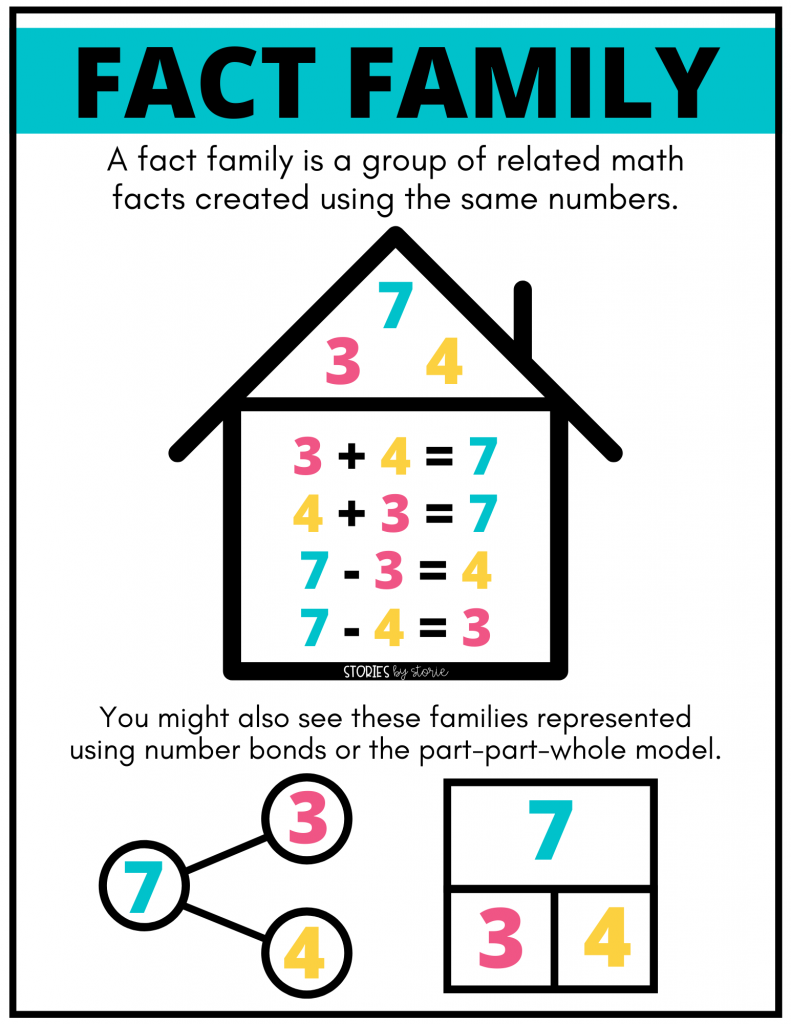
When you're working on fact families, having the definitions and visual models can be a helpful reference tool for students. Here's an anchor chart you can make for fact families and related facts.

Why Teach Fact Families?

Fact families help students see how addition and subtraction are related. When students see the relationships within a fact family, they begin to see mathematical properties like the commutative property (a+b = b+a). This means they see that the answer is the same even when the addends are switched around. They see the part-part-whole model for addition and subtraction. This means that when you put two parts together, you make a whole group. Or, when you take one part from the whole group, you’re left with the other part.


Fact Family Games and Activities

Make it Visual

When students are first starting to add numbers and learn about the commutative property (aka turn-around or flip-flop facts), adding a visual can be very helpful. One way you can do this is with colored counters. Students use one color for each addend. They can physically move the two groups of counters around and see that no matter which order they are placed, the sum remains the same. This is what it might look like for the problem 2+5=7.
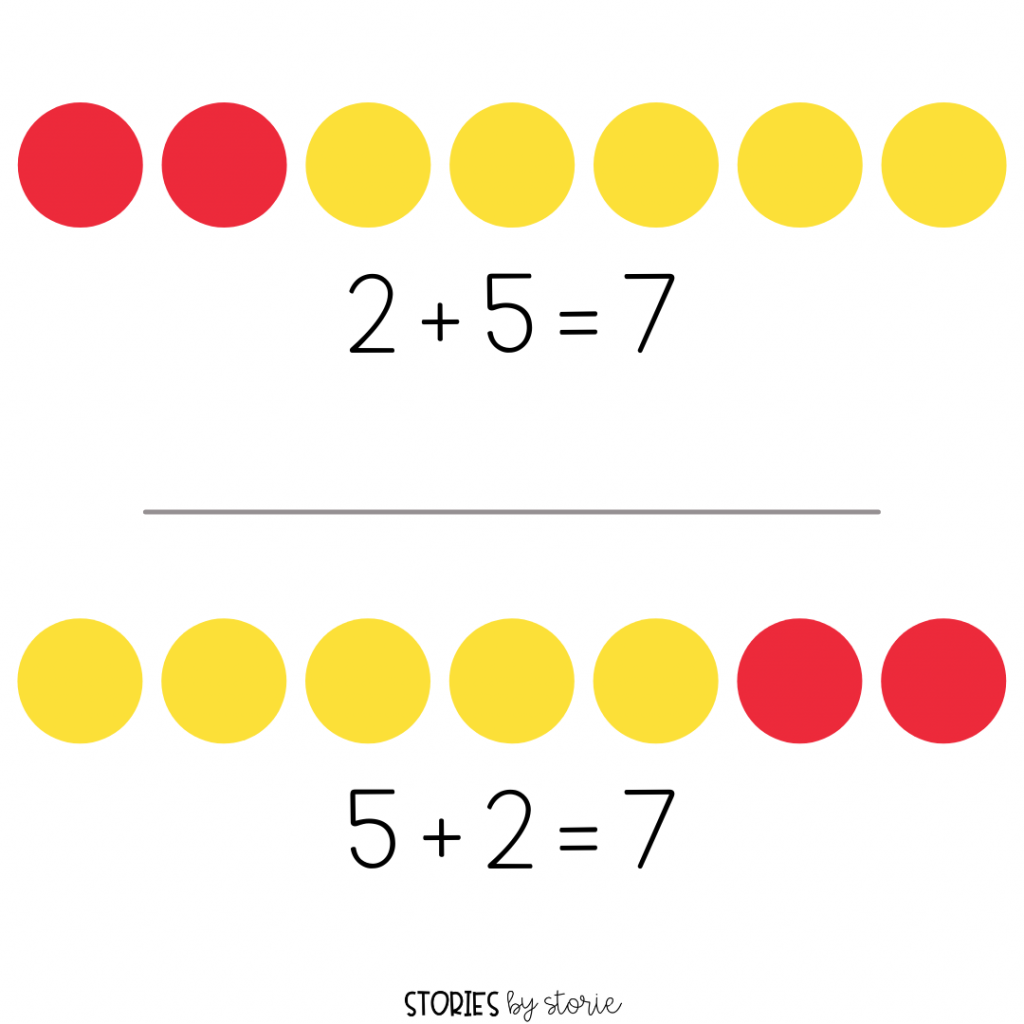
When students are first starting to add numbers and learn about the commutative property (aka turn-around or flip-flop facts), adding a visual can be very helpful. One way you can do this is with colored counters. Students use one color for each addend. They can physically move the two groups of counters around and see that no matter which order they are placed, the sum remains the same.

Create a Fact Family House

Since related facts are often called a fact family, it seems natural to use a home to represent the family. The roof holds the three members of the family, and the base of the house holds the four related facts. You can grab a free template here. If you place the page in a sheet protector or dry erase pocket, the page can be reused again and again.
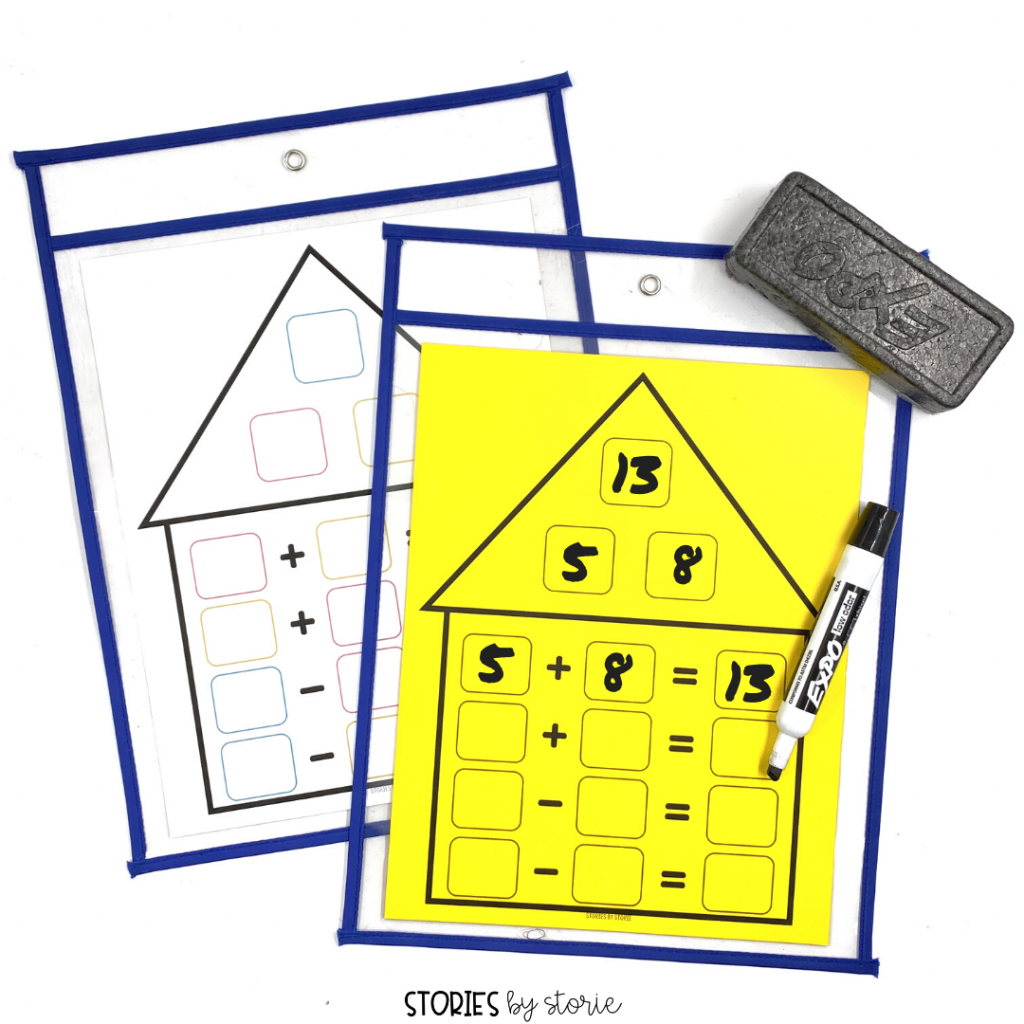
Since related facts are often called a fact family, it seems natural to use a home to represent the family. The roof holds the three members of the family, and the base of the house holds the four related facts. You can grab a free template here. If you place the page in a sheet protector or dry erase pocket, the page can be reused again and again.

You can also use this opportunity to incorporate art and have students create a house out of paper. Each window lifts up to reveal one of the four related facts in the fact family. Grab this free template to use with your own students.
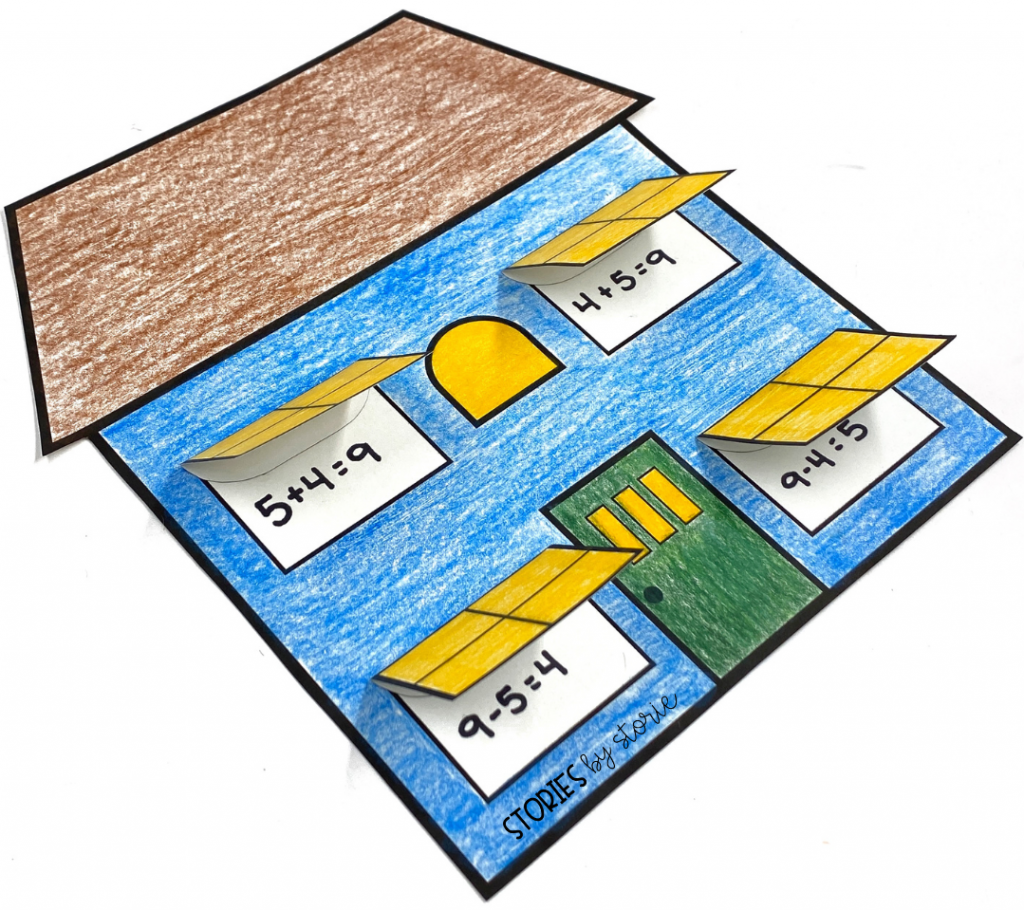
Want to incorporate art into your math block? Let students create a fact family house. Each window lifts to reveal one of the four related facts in the fact family.

Fact Family Dice Game

You know I love using math manipulatives to provide hands-on learning for students and dice are one of my favorite tools. For this activity, students roll the dice to create two addends. Students add the numbers to find the third member of the fact family.
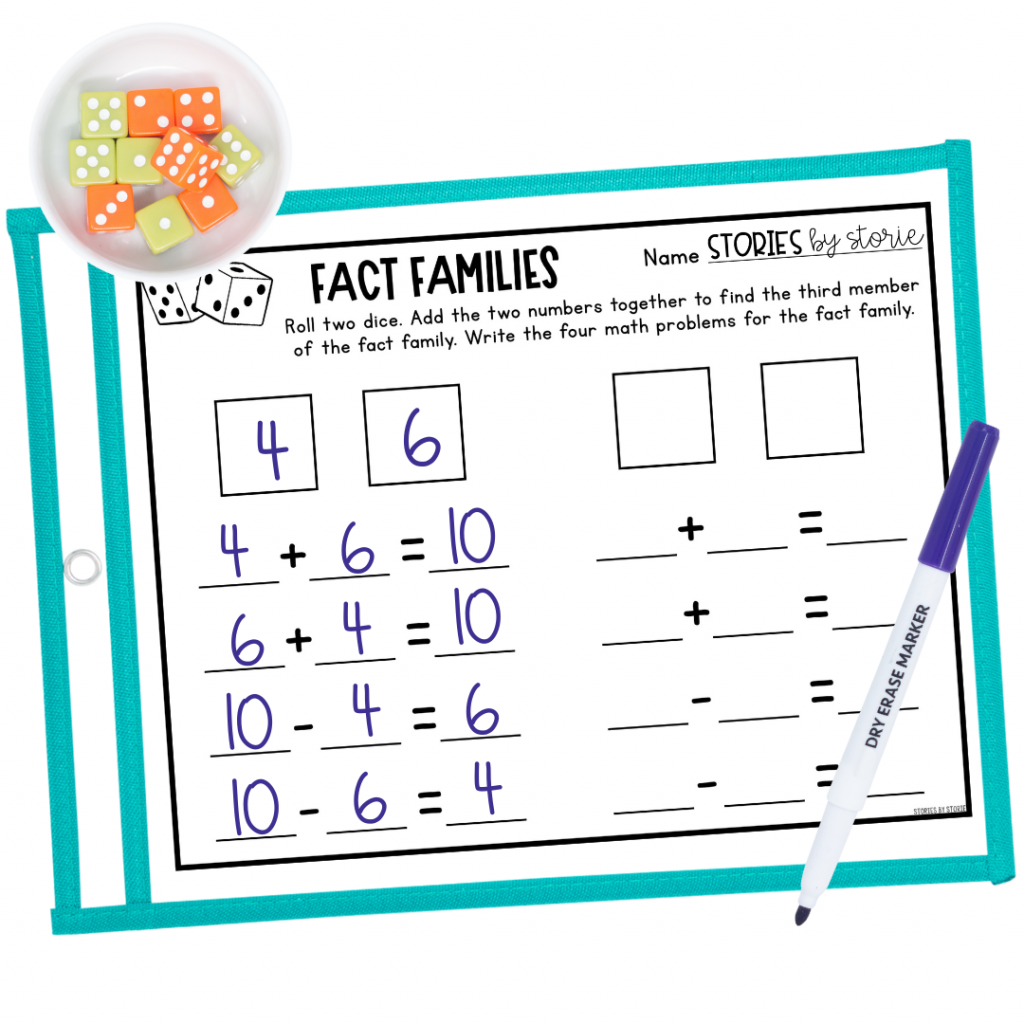
For this fact family dice game, students roll the dice to create two addends. Students add the numbers to find the third member of the fact family and then record the four related math facts.

You can find this activity in my Dice Games pack.


Add Movement

For this activity you will need 5 or 6 students, white boards, dry erase markers, and a bit of space in the front of the classroom. Give each of the students a white board to hold. Choose a fact family and write one number or symbol on each board (make sure they are out of order). Students will look at the information and 5 of them will physically rearrange themselves to make an accurate fact family equation. Once the equation is correct, challenge them to move around again to create a new equation. Repeat until all four equations have been created. You can repeat this process with a new group of students and a set of new numbers.
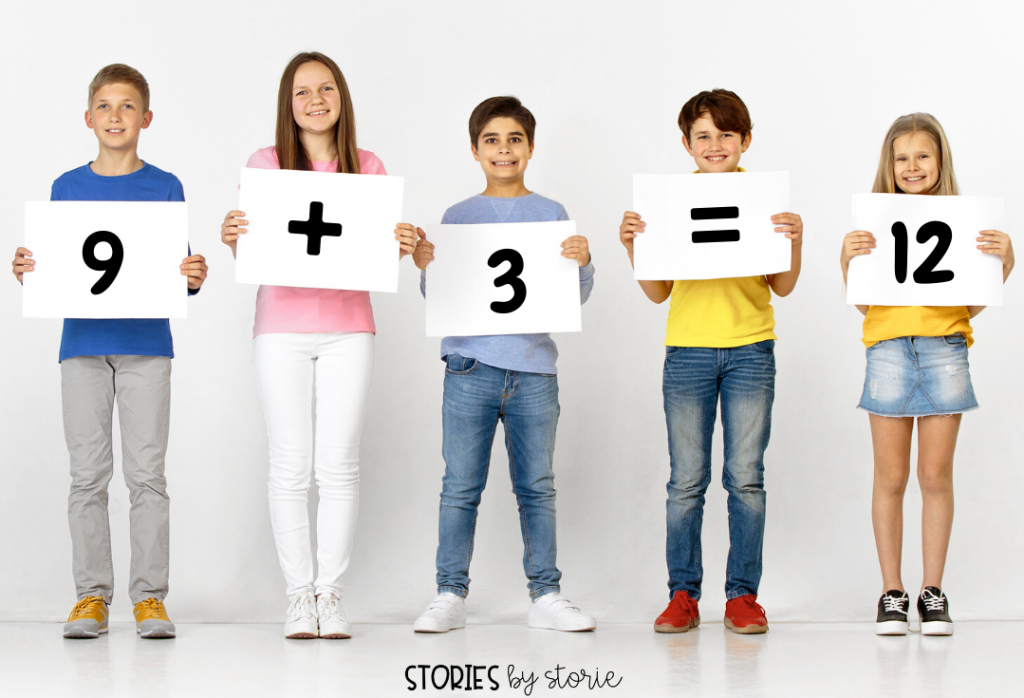
Get your students up and moving with this activity. Each student holds a white board with a number or math symbol on it. Students physically move around to create four related facts for each fact family.

If you are working with a small group, give students sticky notes or number/symbol cards. Call out three numbers. Students physically move the cards around to create the fact family on the table in front of them.


Fact Family Dominoes

If you have a set of dominoes lying around in your classroom, get them out and put them to use. For this activity, students draw a domino and add the two numbers to create the third member of the fact family. Then students record the four related facts and repeat the steps until the page is complete.
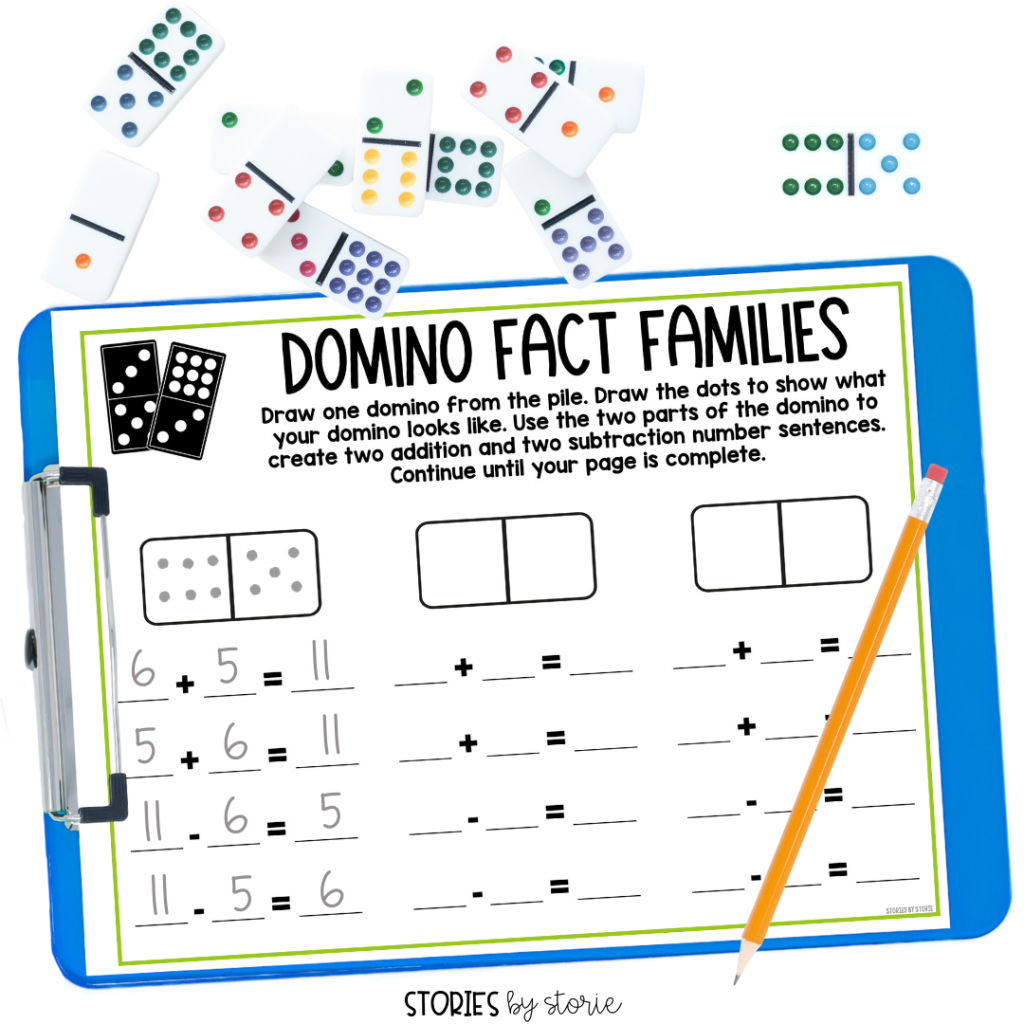
If you have a set of dominoes lying around in your classroom, get them out and put them to use. For this activity, students draw a domino and add the two numbers to create the third member of the fact family. Then students record the four related facts and repeat the steps until the page is complete.

You can find this in my Dominoes Activities pack.


Find a Fact Family

This is a 2-player game, but could also be played independently. Grab a deck of cards and remove the face cards (J, Q, K). Shuffle and lay face down in a stack. Draw four cards and place them face up next to the deck. On a player’s turn, he looks at the four cards and tries to find an addition fact family. In this example, the student might say 3+5=8. He would collect the three cards and replace the empty slots with new cards from the deck.
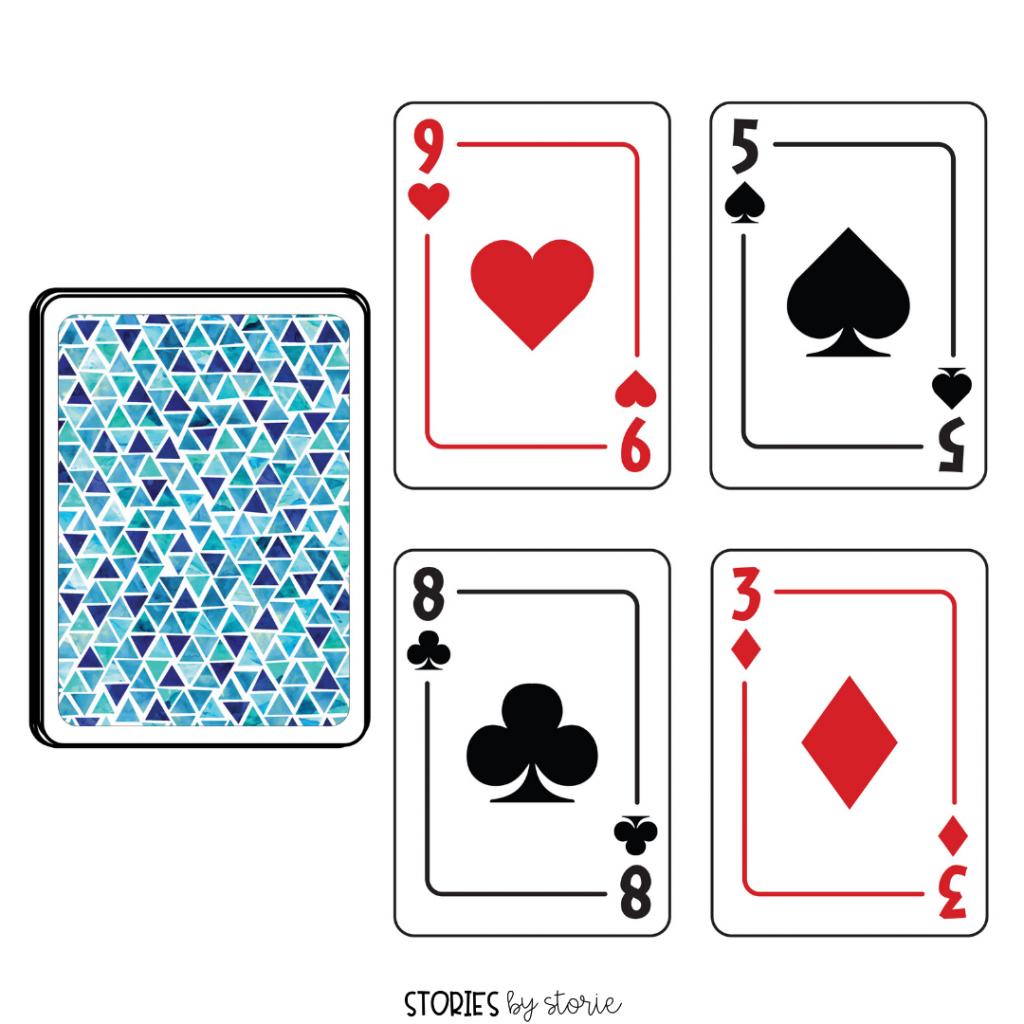
Find a fact family is a fast-paced card game that helps students identify fact families. This game can be played independently or with a partner.

If there are no facts to be found, the player draws one card and lays it over any one of the other cards that are showing and the other player takes a turn. When no more fact families can be made and the deck is empty, the game is over. The player with the most cards collected wins.


What are your favorite ways to work on fact families in the classroom?

You might also enjoy these math games and activities:

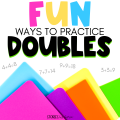
  • Fun Ways to Practice Doubles
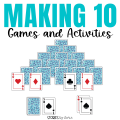
  • Making 10 Games and Activities
  • Telling Time Games and Activities
  • Counting Coins Games and Activities
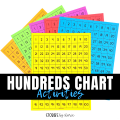
  • Hundreds Chart Activities

Happy Teaching!
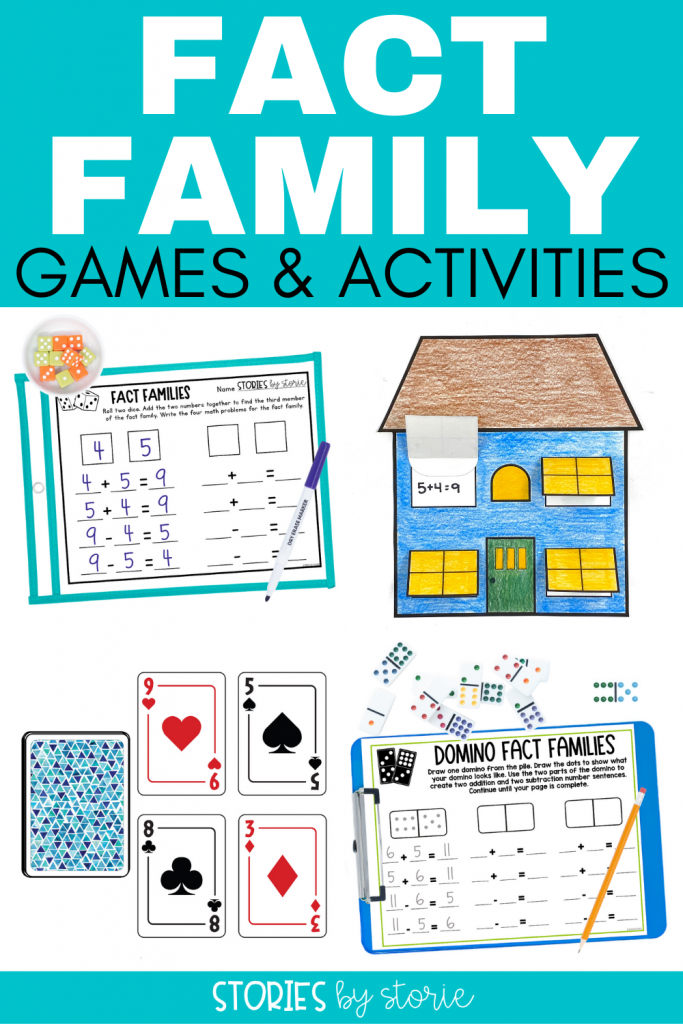
Learning fact families not only helps with fact fluency, but it also helps give students the strategies they need to solve larger addition and subtraction problems. Here are several games and activities to help students with fact families and related facts.
signature

Related posts:

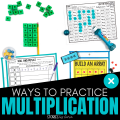
Multiplication facts are an important building block for so many math skills, but many students struggle to learn their facts. How can we help? We can teach them vocabulary and strategies, but we also need to make time for hands-on learning and games. Here are some fun ways to practice multiplication.Fun Ways to Practice Multiplication Hundreds Chart Activities Making ten is a key building block that helps students mentally add bigger numbers as they get older. So how can we make sure kids know all of their tens partners or ways to make 10? We practice! Here are some of my favorite games and activities for making ten.Making Ten Games and Activities Fun Ways to Practice Doubles Are your students working with money? Try these counting coins games and activities!Counting Coins Games and Activities
«
»

Filed Under: math, teacher tips Leave a Comment

Leave a Reply Cancel reply

Your email address will not be published. Required fields are marked *

Search

Categories

Latest on Instagram

🤪 APRIL FOOLS’ DAY: Yay 👍🏻 or Nay👎🏻? When you thi 🤪 APRIL FOOLS’ DAY: Yay 👍🏻 or Nay👎🏻?

When you think of April Fools’ Day, what comes to mind? Hand buzzers? Frozen cereal? Brown Es (brownies)? 

Kids love opportunities to feel silly and some grown-ups do, too. Whether you love or loathe this holiday, there are some great April Fools’ Day books for kids.

The Case of Old MacDonald and His Farm by Mark Teague is a new release that is perfect for the upcoming holiday! 

Something mysterious (and slightly silly) is up at Old MacDonald’s farm. Thank goodness Officer Busby is on the case! 

🔎 Who painted faces on the cabbages?
🔎 Why is pizza being delivered to the goats? 
🔎 How did the cows get mustaches?

Officer Busby suspects Skunk and his crew, who she has been tracking all over the county. They are worse than dangerous - they’re silly! And the most important clue might just be what day it is…April Fools’ Day! 🗓️

Do you have a favorite April Fools’ Day book to read?

Thank you to @simonkids for sharing this book with my family! #SimonKidsCrew

🔗 Want to see the full list of books for April Fools’ Day? 
Blog Post: https://storiesbystorie.com/april-fools-day-books-for-kids/

Amazon: amzn.to/4m2T8AA
(affiliate link)
My favorite library find this week takes us on a j My favorite library find this week takes us on a journey to see the hidden gems that lie in the tiny worlds most of us are too busy to notice.

When a young boy visits his grandmother’s house, he doesn’t just see scraps of ribbon lying around, mushrooms clustered under a log in the forest, or shells hiding along the beach. He sees tiny worlds where pie tins become playgrounds, ants become farmers, and tide pools teem with life waiting to be explored. 

These tiny worlds are full of whimsy and imagination, but they have one problem: He seems to be the only one who sees them. While at first Grandma keeps trying to draw him out to a busy park or the beach or the zoo, eventually she realizes that her grandson’s tiny worlds are big enough for her to meet him there. 

This book uses beautifully detailed illustrations to share a message about stopping to appreciate the small things, the importance of connection, and accepting others for who they are. It would be a great book to share with any child whose imagination comes to life no matter where they go!

Have you seen this book yet?

➡️ Swipe to take a peek inside!

Tiny Worlds
📚  @candlewickpress 
✏️🎨 @cicchese.art
Bring on the butterflies because it’s #twosday ! Bring on the butterflies because it’s #twosday !

Both of these amazing and beautifully illustrated books feature the monarch butterfly. Not only do they highlight the incredible and difficult journey these butterflies make, but they also offer ways kids can get involved to help!

The Monarch
✏️ Kirsten Hall
🎨 Isabelle Arsenault
📚 @simonkids 

If you loved The Honeybee, you’ll want to check this one out! Told through rhyming verse, readers get an up-close look at the life cycle of the monarch butterfly. With a pleasing color palette and the occasional cartoon-like speech bubbles, it really does feel like you’re right there cheering for these fascinating creatures!

 
Home is Calling
✏️ Katherine Pryor
🎨 Ellie Peterson
📚 @worthykidsbooks 

Vibrant illustrations pair perfectly with this story told from the perspective of the monarch butterfly. Despite the long and difficult journey, readers will appreciate just how incredible these insects are.

A BIG thank you to the publishers for sharing these books with my family! They would be a fantastic addition to your butterfly or life cycle unit.

Have you read either of these books yet? Swipe to take a peek inside each book!
My favorite library find this week takes an up clo My favorite library find this week takes an up close look at the epic journey of a Pacific salmon.

If you live in the PNW, the 4th grade students probably study the salmon life cycle at some point during the year. If they’re lucky, they even get to help care for some of the eggs for months at their school before releasing the salmon fry into a local creek. I know I got to do this when I taught 4th grade, and my own kids did, too!

This book combines beautiful illustrations with inviting & informative text that captures each unique stage of the Coho salmon. The back matter provides additional information about the life cycle stages. It would be a fantastic addition to your salmon or life cycles unit!

➡️ Swipe to take a peek inside!

Have you seen this book yet?

Salmon Run; An Epic Journey to the Ocean and Back
📚 @redcometpressbooks 
✏️🎨 @annichenn
🐷🐷🐷 There’s something timeless about The Three Li 🐷🐷🐷

There’s something timeless about The Three Little Pigs that captures the imagination of readers of all ages. Whether you reach for the traditional tale or one of the fractured versions, these stories offer a delightful mix of adventure, cleverness, and humor!

What’s your favorite version of The Three Little Pigs?
💛 LIBRARY STACK 💛 Thought I’d stop and take a mom 💛 LIBRARY STACK 💛

Thought I’d stop and take a moment to admire my current checkouts from the local library, especially since I was recently reminded that February is National Library Lovers’ Month. 

Do I often get strange looks and questions when another patron sees me with a large stack of picture books at the self-checkout desk? Yes, but that hasn’t stopped me! 

Which titles from this stack would you reach for first?
My favorite library find this week dives deep bene My favorite library find this week dives deep beneath the surface to explore hidden treasures.

Alternating between verse and facts, this book gives readers a front row seat to some of the biggest shipwrecks ever found. We also get introduced to some of the scientists, divers, and treasure hunters behind these discoveries. 

Whether you know an aspiring marine archaeologist or someone who loves a good treasure hunt, this book would be a good fit for any curious, adventurous reader!

Have you seen this book yet?

Shipwreck
📚 @tilburyhousepublishers 
✏️ Deirdre Laide
🎨 Carlos Velez Aguilera

Copyright © 2026 · Website Design By Jumping Jax Designs