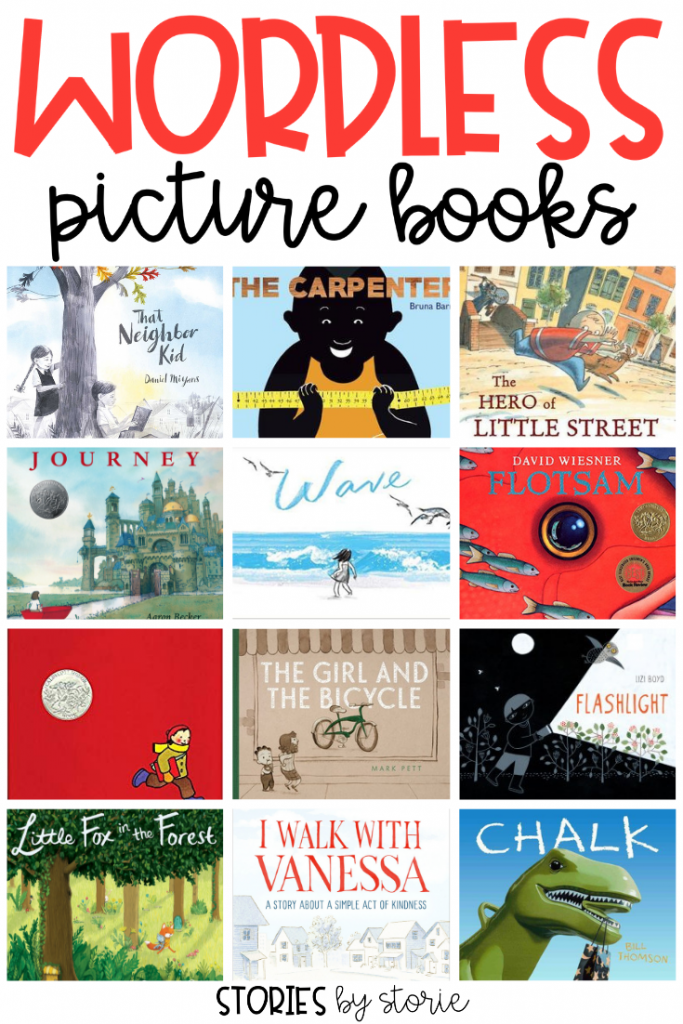





Wordless picture books are not just for your non-readers. In fact, they can sometimes be more difficult because they require a reader to dig deeper and use higher level thinking skills. Wordless picture books allow opportunities to observe, ask questions, make inferences, draw conclusions, and more! Here are some of my favorite wordless picture books for kids.

You can click on any of the titles below to learn more about each book or find all of these wordless picture books on my Amazon page.
we are a participant in the amazon services llc associates program, an affiliate advertising program designed to provide a means for us to earn fees by linking to amazon.com and affiliated sites.
Wordless Picture Books for Kids
I Walk with Vanessa by Kerascoet

This picture book tells the story of Vanessa as she gets bullied on her way home from school. Another little girl sees what happens to Vanessa and the illustrations show how deeply this act impacts her later that day. The next morning, this little girl makes a powerful choice, which not only demonstrates kindness to Vanessa, but inspires other students to stand together.
The Girl and the Bicycle by Mark Pett
A little girl sees a shiny new bicycle in the shop window. She hurries home to see if she has enough money in her piggy bank, but when she comes up short, she knocks on the doors of her neighbors, hoping to do their yardwork. They all turn her away except for a kindly old woman.
The woman and the girl work through the seasons, side by side. They form a tender friendship. When the weather warms, the girl finally has enough money for the bicycle. She runs back to the store, but the bicycle is gone! What happens next shows the reward of hard work and the true meaning of generosity.
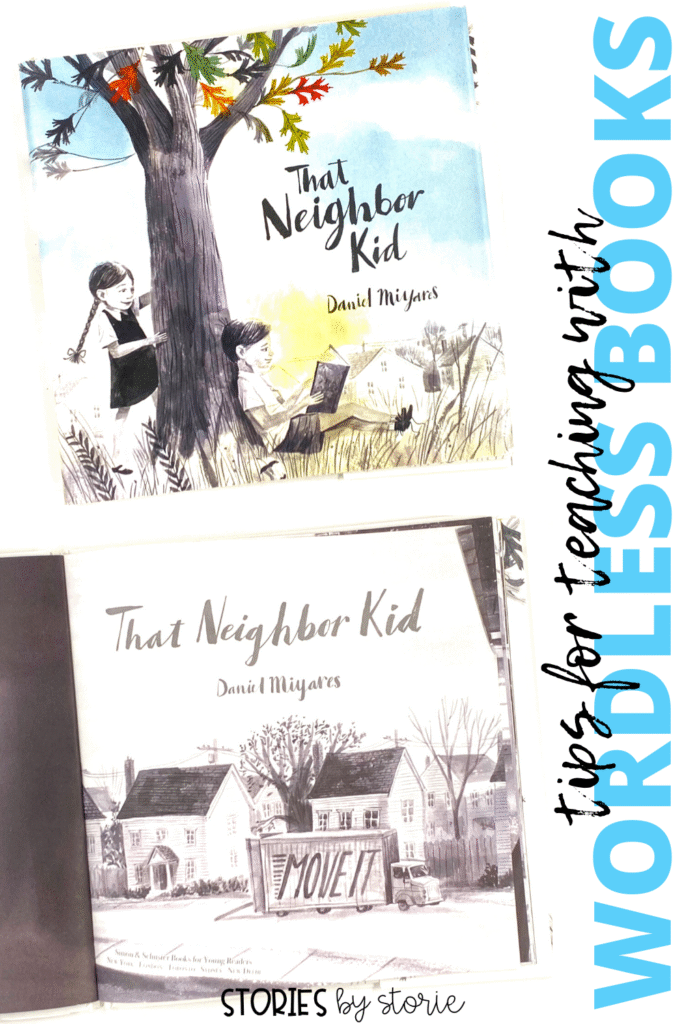
That Neighbor Kid by Daniel Miyares
There’s a new boy in the neighborhood, and he’s up to something very curious. His next door neighbor, a girl his age with two long braids, peeps around corners and watches as he scavenges wood from the fence between their houses, drags around a hammer and a bucket of nails, and reads a book about living in trees. When she finally works up the courage to say “hi,” she finds herself invited to help build the private getaway every child has dreamed of: a tree house. She also finds herself with a new best friend.
Rosie’s Glasses by Dave Whamond
Rosie wakes up in a monochrome world, with a dark cloud over her head. As she plods through her miserable, gray day, the cloud follows. Mishaps and mayhem thwart her every move, irritating noises assault her — and the pouring rain makes everything worse. But then, on her way home from school, Rosie finds a pair of strange glasses. When she puts them on, her world transforms into vivid, joyful color. All of a sudden, she can see the beauty and fun in everything around her — and her dark cloud has disappeared. Are the glasses magic? Or could it be that changing how we look at the world can change the way we experience it?
The Carpenter by Bruna Barros
A young boy abandons his beloved electronics when an old-fashioned yellow-jointed tape measure causes his imagination to run wild. This book shows the simple joys found in exploration and creative play.
Flotsam by David Wiesner
A bright, science-minded boy goes to the beach equipped to collect and examine flotsam–anything floating that has been washed ashore. Bottles, lost toys, small objects of every description are among his usual finds. But there’s no way he could have prepared for one particular discovery: a barnacle-encrusted underwater camera, with its own secrets to share . . . and to keep.
Journey by Aaron Becker
A lonely girl draws a magic door on her bedroom wall and through it escapes into a world where wonder, adventure, and danger abound. Red marker in hand, she creates a boat, a balloon, and a flying carpet that carry her on a spectacular journey toward an uncertain destiny. When she is captured by a sinister emperor, only an act of tremendous courage and kindness can set her free. Can it also lead her home and to her heart’s desire?
Little Fox in the Forest by Stephanie Graegin
When a young girl brings her beloved stuffed fox to the playground, imagine her surprise when a real fox takes off with it! Join the girl and her friend, the boy, as they follow the little fox deep into the forest…and discover a wondrous and magical world.
Once Upon a Snowstorm by Richard Johnson
A father and his son get separated outside during a snowstorm. The boy is lost and falls asleep. When he wakes up, he is surrounded by creatures all around him. He becomes friends with the creatures, but starts to miss his dad, so the animals bring him back home. What will happen when Dad sees the animals with his son?
The Hero of Little Street by Gregory Rogers
Narrowly escaping from a gang of bullies, a boy slips into a grand old gallery – the perfect hiding place, full of mystery and treasures. Suddenly, a painting comes to life and the boy finds himself on an adventure led by a mischievous little dog that has leapt from the canvas. The two slip into a Vermeer painting and are transported to Little Street, Delft in seventeenth century Holland. But the streets of Delft are a dangerous place for a dog, and the boy has to use every ounce of ingenuity to rescue his new friend from an untimely fate.
On Christmas Eve by Peter Collington
On Christmas Eve, a little girl writes a letter to Santa Claus, hangs up her stocking, and eventually falls asleep. Like all children, she wonders what really happens to Santa Claus on his cold midnight journey. How does he manage to travel so far? How does her find her house? Her room? And most important of all, how does he get in if the house doesn’t have a chimney?
Chalk by Bill Thomsen
Three children find a bag of magical chalk at the playground on a rainy day. Their drawings come to life, which seems great when a drawing of the sun stops the rain, but is scary when a dinosaur stalks them. A drawing of a rain cloud inside a play tube brings the rain back and dissolves the frightening creature.
Pool by JiHyeon Lee
What happens when two shy children meet at a very crowded pool? Dive in to find out!
The Red Book by Barbara Lehman
This book is about a book. A magical red book without any words. The Red Book crosses oceans and continents to deliver one girl into a new world of possibility, where a friend she’s never met is waiting. And even when you reach the end of the story, you’ll discover that the journey is not over.
Rainstorm by Barbara Lehman
It can be lonely sometimes on a rainy day in a big house with no one else around and only the quiet to keep you company. But if you find a key, a mysterious key, that leads you to an unexpected place…chances are your afternoon is about to get a lot more interesting!
Wave by Suzy Lee
Through only two shades of watercolor, this book tells the story of a little girl’s day at the beach. This story begins and ends with a wave, but a friendship develops in between.
The Line by Paula Bossio
A little girl finds one end of a line – a simple but amazing line able to transform itself into any number of things, including a slide, a bubble, a jungle vine-swinging monkey, and even a hungry monster! What – or who – could be at the other end?
Flashlight by Lizi Boyd
Inside a tent it’s cozy. But what is going on outside? Is it dark? Is it scary? Not if you have your trusty flashlight!
Pip and Pup by Eugene Yelchin
Across the barnyard, Pip the chick spots a new friend to play with―Pup! But Pup isn’t sure he likes how Pip plays―too rough. These two friends will weather the storm though and find friendship along the way.
Draw by Raul Colon
A boy named Leonardo begins to imagine and then to draw a world afar—first a rhinoceros, and then he meets some monkeys, and he always has a friendly elephant at his side. Soon he finds himself in the jungle and carried away by the sheer power of his imagination, seeing the world through his own eyes and making friends along the way.
Where’s Walrus? by Stephen Savage
Walrus has escaped from the zoo! Will the zookeeper find him? Or will this clever runaway stay one step ahead by disguising himself among firefighters, businessmen, and even high-stepping dancers?
Tips for Using Wordless Books in the Classroom
What are Wordless Books?
A wordless book tells a story solely through its illustrations. These books are a valuable literacy tool because they engage children of all ages and abilities to predict, question, sequence, analyze, and construct meaning. Wordless books provide opportunities for developing vocabulary and having rich discussions about story structure.
How to Read a Wordless Book
Book Cover and Title Page
Just as you would with any other book you are about to read, you should start with the book cover and title page. Ask your students questions. What do you notice? What clues do you see about the story? Does the title give you an idea of what the story will be about? What does an illustrator do? Why are illustrations or pictures important to a story?
Make a Prediction
Based on the cover and title page, what do you think this story is about?
Take a Picture Walk
Look through the pages of the book for enjoyment. Stop and point out anything that immediately draws your attention. Ask, how does the story match the title and cover illustration?
Read the Story
In the beginning, you might need to take the lead and model the different ways to read a wordless book. Be sure to let the discussion determine how much time is spent with each page.
Beginning with the first page, point to details you notice in the illustrations.
- Describe what you see and connect those images with rich vocabulary and word choice.
- Ask questions (What if…? Why do you think…?, etc.).
- Use sequencing words (next, then, later, etc).
- Invite students to use their schema to make connections.
- Invite students to confirm or change their predictions.
- When your students become more comfortable, take turns reading the pages. If reading in a small group, have a moment of silence for all students to gather their thoughts. Then let students share and build upon one another’s stories.
Questions for Wordless Books
Do you still feel stuck on what to talk about? Here are some questions you might ask when sharing a wordless book with your students. Every wordless book is different, so get creative and let your students help guide the discussion.
- Does the title give you a clue to what the story might be about?
- What do you notice in the illustrations?
- What do you think this book will be about?
- What is happening?
- Who is this story about?
- What does this character want or need?
- What is this character feeling? How do you know?
- Have you ever felt this way?
- When and where does this story take place?
- What season is it? How do you know?
- Is there anything unfamiliar about this setting?
- What do you think will happen next?
- If you were the character, what would you do?
- Was there anything you would add to this book?
- Was there anything you would take out of this book?
- What was your favorite part?
- What was your least favorite part?
- Have you ever had an experience like the one in this story?
- Which illustrations helped you tell the story?
- Which illustration would you have chosen for the cover of the book and why?
- What happened at the beginning of the story?
- What happened it the middle of the story?
- What happened at the end of the story?
- Why do you think this book doesn’t have words?
- Do you think this book needs words to tell the story and why?
Wordless Book Extension Ideas
When you reach the end of a wordless book, don’t be so quick to put it back on the shelf. There are so many things your kids can do to engage and interact with the book. Here are a few ideas you might try:
- Create a word list of nouns, verbs, etc.
- Act out parts of the story and allow students to add dialogue.
- Add sticky notes to the pages with words about what is happening.
- Identify character feelings and emotions.
- Take the book apart (or make copies) and have students put the story back together.
- Write the story. Give each student (or small group) one page of the story. Have them write a sentence about what they think is happening on the page. Gather all of the pages together and read the new story.
- Change the setting. How would this book be different if it took place in another place or season?
- Have students create a wordless book of their own. Students can either draw illustrations or take photographs for their book. Place these in the classroom for all students to enjoy.
So grab a wordless book or two and teach your students just how amazing they really are!
Please note: these ideas were previously featured on a post I wrote for Conversations from the Classroom.
I know there are even more great wordless picture books for kids out there just waiting to be opened. What are some of your favorites? I’d love to check them out!
You can find even more book lists organized by topic here.
Happy Reading!